China’s GBA rail loop: Unifying the world’s first true megalopolis

To truly integrate the Greater Bay Area, China must build its most ambitious rail project yet: a continuous loop through the world’s densest urban corridors.

The Guangdong – Hong Kong – Macao Greater Bay Area (GBA) is a megalopolis comprising nine mainland cities and two Special Administrative Regions (Hong Kong and Macao) in southern China. Connecting the GBA would bring together over 86 million people and a combined GDP of CNY14.8 trillion (US$2 trillion).

In the last 30 years the GBA region has transformed into a global hub of innovation in high-tech manufacturing and finance serviced by an expansive, integrated network of over 2,000kms of rail and metro lines. A key part of the transformation has been investment into an extensive fast-rail intercity network.

However, this vast network has emerged as a series of overlapping hub and spoke’ city metros overlayed with a web of high speed and fast intercity rail lines that can be difficult for passengers to navigate and visualise holistically.

London pioneered the urban rail circuit with its 27km Circle Line, a model later expanded upon by Tokyo (31km), Chongqing (51km), and Moscow — currently the world’s longest at 57km. While Paris (75km) and Melbourne (90km) are planning even more expansive loops, these remain primarily orbital lines designed to service outer suburbs.

By contrast, the proposed GBA Loop operates on a different scale entirely. Spanning approximately 380km, it would far exceed any existing global precedent, functioning not just as a suburban link, but as the primary connective tissue tethering multiple cities into a singular, high-performance megalopolis.

An intercity rail loop would unify the current network creating fast region-wide connections to fully integrate a majority of GBA transport. 

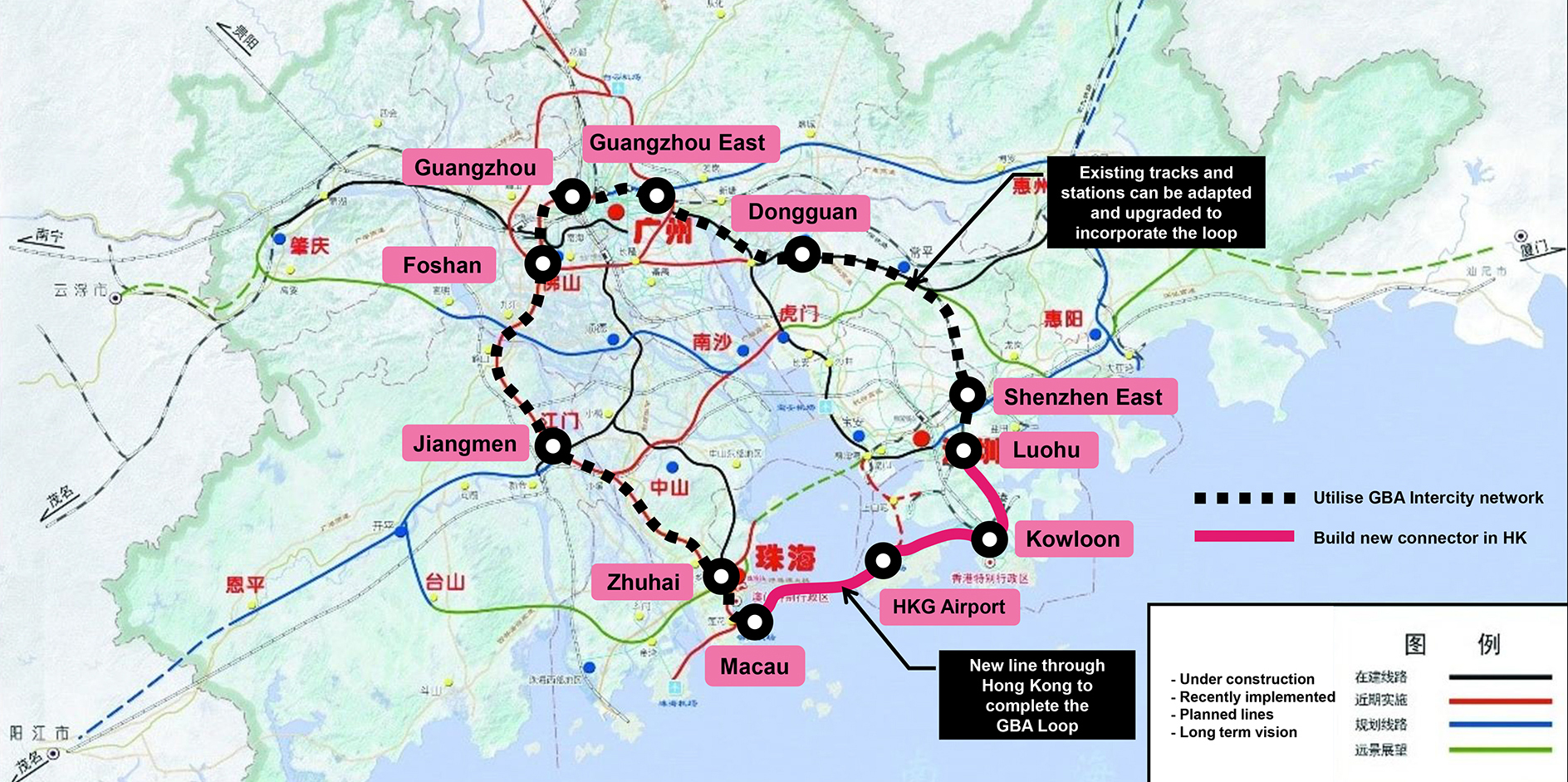
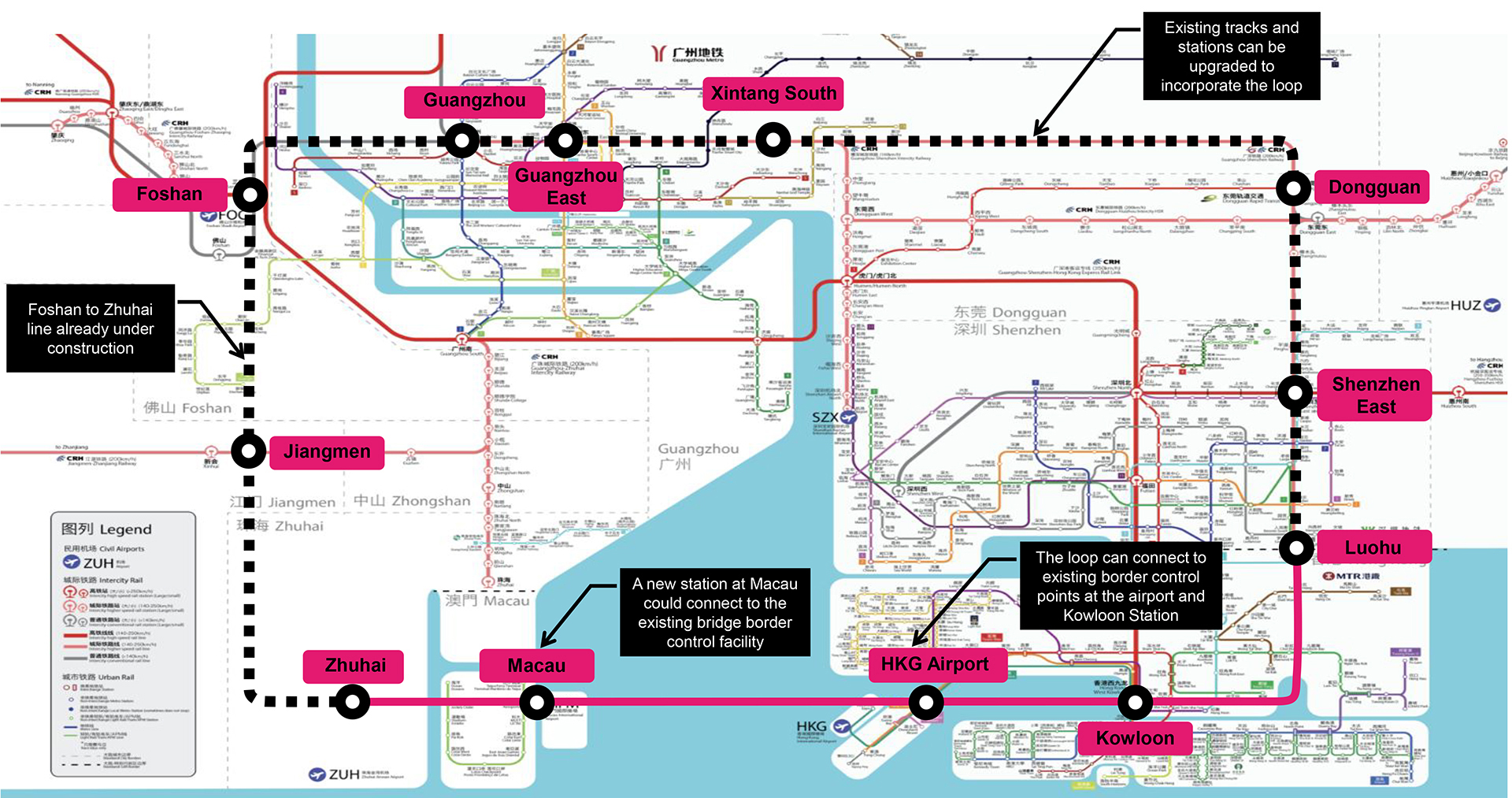
As it now stands, the existing network of intercity rail corridors can be adapted, with the addition of a new line in Hong Kong, to form a continuous GBA Loop.

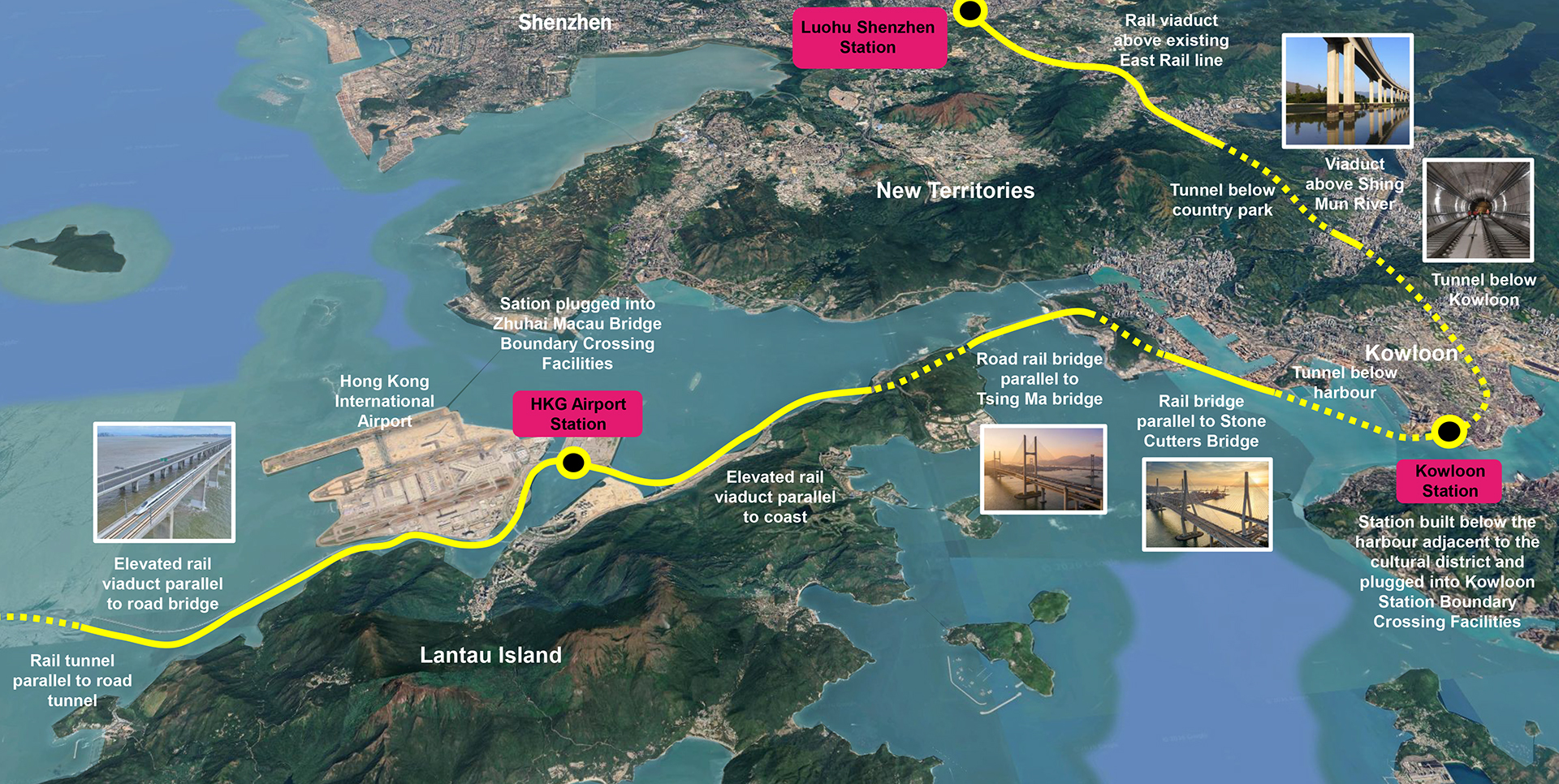
This is not an easy task – it would likely require the largest single investment in a transport infrastructure project that the region has seen – but China does infrastructure well and has a track record of delivering transformative mega projects. One of the biggest challenges will be threading the loop through some of the most densely populated districts in the world, including Hong Kong, and the sensitivities of transiting through border control points.

Our proposed route (pictured) follows existing transport corridors, weaving elevated and subterranean sections through the region. It’s a design that respects the complexity of current border controls while envisioning a future of frictionless movement.

The GBA Loop is more than an engineering ambition; it is a conceptual framework for the world’s first truly integrated megalopolis. By tethering the Pearl River Delta’s distinct urban identities into a singular, sustainable economic powerhouse, the project transcends the traditional hub and spoke model.

In an era defined by rapid urbanisation and the urgent need for low-carbon mobility, the loop offers a vision of the region as a fluid, borderless ecosystem. For the 86 million people who call this area of southern China home, it promises a future where the distance between opportunity and community is measured in minutes, not miles. If realised, it would not just move people — it would redefine the very shape of the modern global city.

The infrastructure is already there. The vision is what remains to be built.

Written by Peter Morley, Hassell Managing Principal and co-leader for the urban transport sector based in our Hong Kong studio. He has been leading the design of transportation projects globally for over 30 years.

WeChat QR Code

扫描二维码关注Hassell微信公众号